


It’s a bit like the return of the three astronauts in the Apollo 13 spacecraft to the Earth’s atmosphere as reflected in the last minutes of Ron Howard’s nail-biting film Apollo 13. Literally at the time of this post, 12:10 a.m. U.S. Central time, August 6, 2012, white-knuckled NASA engineers, scientists and administrators are watching their computer monitors to see if their $2.5 billion gamble paid off. The space rover Curiosity is just seconds from landing on the surface of Mars. More than 150 million miles away, we won’t actually know the status of the mission landing for another 14 minutes because of the long communication lag. If successful, the small car will roam the mountains of the Red Planet for the next two years, learning each day more than the sum total of knowledge amassed in the history of our distant study of the planet.

The Mars Science Laboratory Mission has been in its space travel phase for eight months now, leaving Florida’s Kennedy Space Center last November toward the solar system’s fourth planet from the Sun. But now it actually has to achieve its descent successfully, and this will be more difficult than landing predecessor rovers Pathfinder, Spirit, and Opportunity. The vehicle named Curiosity weighs much more, approximately a ton of material to gingerly float to the surface. NASA is deploying an untested “sky crane,” which looks amazingly like the Nostromo or Prometheus. Eight engines on each corner of the sky crane will fire to slow the descent of the equipment and rover in its last seconds, deploying NASA’s largest parachute yet in the process.
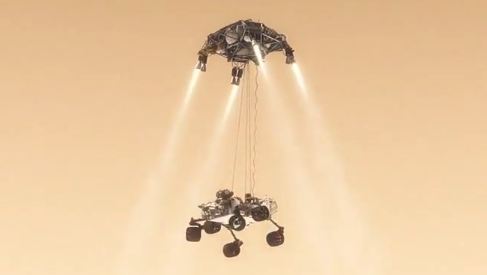
NASA’s website offers this video showing the stages of the landing, called Curiosity: Seven Minutes of Terror (which sort of sounds odd for NASA, since we’re talking about hunks of metal and wire and no lifeforms affected, but don’t miss this video, as it is well-made and shows engineers laying out computer graphics of the stages we never will be able to actually watch):

Even better, NASA asked Wil Wheaton and William Shatner to explain the landing process for Curiosity. Very cool! Here is Wheaton’s version:

And here is Shatner’s version:

It’s sort of funny that NASA chose to use the same script for each actor (I like Wheaton’s more).
What’s happening right now, 154 million miles away:
- Curiosity enters the atmosphere of Mars at an altitude of about 81 miles and a velocity of 13,200 mph, about 390 miles and 7 minutes from touchdown.
- One minute and 15 seconds after entry, the heat shield will face heat of 3,800 degrees Fahrenheit, which will slow the craft by 90 percent.
- Ten seconds later, deceleration will reach 15 times the force of Earth’s gravity at sea level.
- Four minutes into the atmosphere, the guided entry phase of flight end. Six 55-pound weights will be ejected to help ensure stability when a supersonic parachute deploys.
- At an altitude of about seven miles and racing toward the Martian surface at 900 miles per hour, the gigantic chute will snap to a diameter of 51 feet, resulting in a 65,000-pound, 9 Gs jolt at about Mach 1.7–NASA’s largest parachute ever flown.
- Five miles from touchdown and 24 seconds later, the heat shield is jettisoned. The craft is now descending at 280 mph.
- Curiosity and its rocket pack separate from the chute and its support.
- The rocket-laden sky crane kicks in.
- Four rocket engines shut down. At 70 feet, Curiosity will be lowered on the end of a 25-foot-long tether.
- The rover’s six motorized wheels will snap into position for touchdown at 1.7 mph.
Without manned space shuttles, this is the excitement we can expect from the new stage of NASA science and technology.
So did we succeed? Or as one of the NASA engineers says, will it be “game over”? Check out NASA.gov right now as the first video images are transmitted back to Earth.
1 a.m. update–Success! The rover made it. Good job, NASA!
C.J. Bunce
Editor
borg.com
