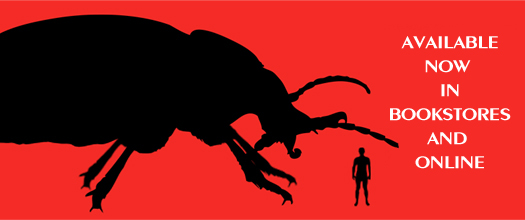
Review by C.J. Bunce
Micro: A Novel


I am always incredibly curious to read a book featuring co-authors or a work finished or packaged posthumously. Louis L’Amour died in 1988 and for years it seemed like his estate kept churning out books as if he were still writing. In the first issues of Kevin Smith’s The Bionic Man


The biggest hurdle in embracing Micro


In Micro when a scientist criticizes another for being a vegetarian—he is written off with the pointed question, “how do you not know plants have feelings, too?” Basically, end of story, vegetarians are illogical. In the preface, quoting statements made by Crichton tied to this novel, Crichton seems critical of global warming theory. We know from Jurassic Park that he embraced chaos theory and the science of complex systems. We know from his work Prey

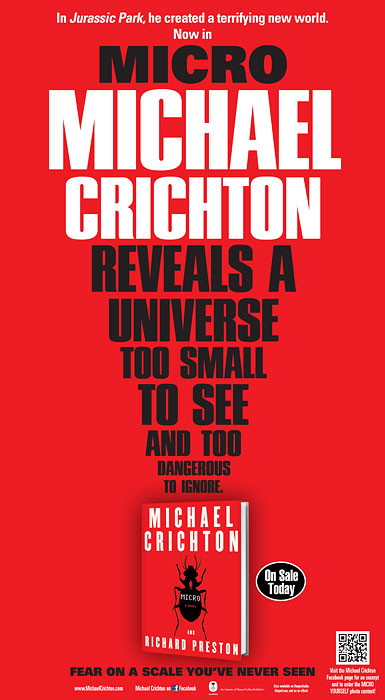
Like Crichton’s sequel to Jurassic Park, The Lost World

- Can you safely carry people around in a plastic baggy?
- Can you envision a vehicle that you can fit into your pocket?
- Could you fly a plane that was an inch long across the entire island of Oahu and arrive at any intended destination, no matter how many times you tried?
- Would the sheer terror of encountering bugs that were bigger than you not induce a heart attack or even slightly put you off kilter so as to not allow you to tap your immense knowledge of the science of beetles to think about ways to assemble poisons to be able to successfully eliminate the creature?
- If your co-worker was held underground by a wasp as a prisoner, to be the wasp’s offspring’s lunch, would any human in any context feel sympathy for the offspring who was to be deprived of his lunch if your rescue succeeds? (As noble and naturalistic a thought this may be, I think terror would win out in any event).
- At what percent of normal function could you function if your arm, as an example, was injected by a giant insect with its larvae, using you as a host? Could you then fly a plane that you’d never seen before, or would you just freak out and cower in the corner, or beg your friend to cut off your arm?
The best part of all Crichton novels is the creation of a small think tank of a half dozen experts of distinct disciplines pulled together seemingly to research some project, only to realize their real purpose is to solve a difficult problem under unthinkable conditions. Crichton creates these mini-universities where ideas can be shared, theories argued and defended. The human condition—personalities, foibles, belief systems, behavior–always gets in the way, but never to the detriment of the entire operation. Here we have seven graduate students, anxious to get their own deals post-grad with private industry. Then Vin Drake, president of tech corporation Nanigen, comes along to recruit. One of the students, Peter Jansen, has a brother Eric who already works there. They all fly to the headquarters on the island of Oahu. First Eric turns up dead, and in attempting a quickly and poorly thought plan to get an admission from the killer, the seven are sucked into the microverse and left to die in the woods.
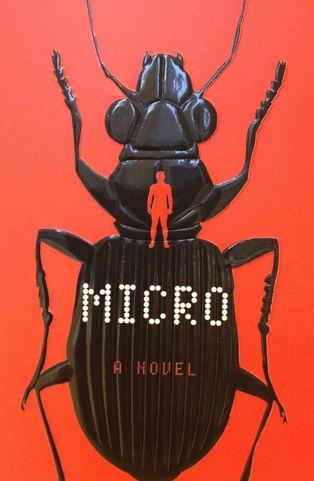
Meanwhile enter a local detective, Police Lieutenant Dan Watanabe (my favorite character in the book), who is part Officer Gunderson from Fargo and part Marshal Gerard from The Fugitive, but would have been nicely played on the big screen by Jack Soo (Barney Miller), Kam Fong (Hawaii 5-0), or Kwan Hi Lim (Magnum, PI). He’s getting misinformation about a group of bizarre deaths, and they all have one company in common. The story works back and forth among Watanabe (just not enough for my taste), the seven students, and the villain of the story and his minions. The ride has its moments.
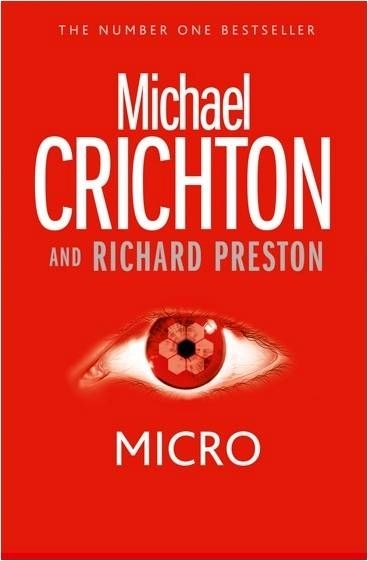
To my surprise, what also becomes most “real” in the novel is what made Jurassic Park real for me—the shock and horror. To this day the most vivid scene for me from any Crichton novel is when a character is hiding in Jurassic Park in some inner hallway in the dark after all the dinosaurs have escaped their pens. Something moves past him and he doesn’t feel much or know what happened, until he reaches down to feel his intestines are in his hands, quickly and seemlessly slashed by some plotting raptor. Several of these gut-churning scenes abound in Micro, all involving the fleshy, oogy, gory, grizzly, and grotesque that would likely occur when encountering bugs head-on when they out-size you. If anything, the encounters as concepts are predictable—get out a sheet of paper and write out every worst-case encounter you would have as an insect—as prey—and you will see each of those scenarios revealed as happening to one of the characters somewhere before the final page. Horrific to be sure, but it’s that kind of thrill that makes you soar to the end to find out what happens to everyone.
The result is a book worthy of Crichton’s catalog, and an interesting last entry for those that have gobbled up everything else he had to offer. Available everywhere books are sold.