


Interview by Elizabeth C. Bunce
Award-winning fantasist Sharon Shinn is the author of two dozen novels and a handful of short stories and novellas. Number twenty four, The Shape of Desire


Shinn, a St. Louis native, is probably best known for her Samaria novels, a loosely-related collection set on a world ruled by genetically-engineered angels; and her Twelve Houses


I’m excited to bring you my conversation with Sharon Shinn!
ECB: You’ve had an amazingly productive career–averaging about one (and sometimes two!) books a year–while also maintaining a fulltime career as a journalist. What’s your secret? (Personally, I suspect a warp in the space-time continuum in your basement, but will understand if you can’t tell us.)
SS: I think the secret is obsessive compulsive disorder. When I have a task with a deadline—any task, any deadline—I feel like I have spiders on my skin. I can’t rest until it’s done (or all the spiders have been brushed off). So when I’m in the middle of a book, I am constantly trying to find an hour here, two hours there, when I can sit down and write. It’s not a comfortable way to live, actually, but it does make me productive.
ECB: What’s your writing process like? How long does it typically take you to write a novel? A novella? How many projects do you have going at once?
SS: I think about a book for a long time—six months to five years—before I sit down to write it. So I usually have a really good idea of the plot and the characters. I think it’s Graham Greene who said that he ruminates on a book so long before he starts writing that “it is not so much written as remembered.” I feel that way sometimes. I generally start a novel early in January and write till it’s done. I start on page one and go straight through to the end, without going back to rewrite or fix things that I’ve decided to change in later chapters. So, you know, my heroine might be named Betsey in Chapter One and Annabel in Chapter 10. The rough draft usually takes me four to six months. Then I go back and do a very detailed rewrite, fixing all the inconsistencies and cutting out the really clunky stuff. Then I go back and do a finer rewrite. Combined, those usually take eight to twelve weeks. Then I have my writer’s group read and critique the manuscript, then I do a final pass, making edits based on their comments. The book is usually ready to be turned in by sometime in September. So…nine months for a book, more or less. A novella I can do in eight to twelve weeks. Same process, just fewer pages. I rarely work on more than one thing at a time. Every once in a while, if I’ve committed to a short story, I’ll stop working on the novel long enough to write the shorter piece, but I really hate stopping my forward momentum on the book. Unless I’ve already finished the rough draft! Then I’m a little more relaxed about taking a break from the novel.
ECB: What would you say the highlight of your career has been so far? Any way-out-there dreams or ambitions, or projects you fantasize about tackling?
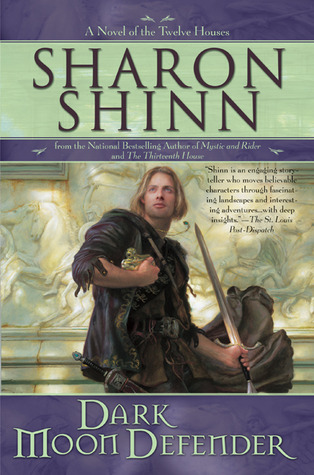
SS: Highlights… Meeting Anne McCaffrey. Writing a check at a small boutique and having the salesgirl gasp, “Oh my God, are you the author? I LOVE your books!” Getting a letter from a fan who had just finished reading Dark Moon Defender

ECB: The Shape of Desire‘s Dante is by no means your first shape shifter character [they also figure prominently in The Shape-Changer’s Wife

SS: It took me a while to realize this, but a huge percentage of my books feature characters who are in disguise in one way or another…the heroine might be using an assumed name or the hero doesn’t know that he’s really the king’s son. Shape-shifters are constantly in disguise! They epitomize the character who is living a lie! So I think, for me as an author, that’s their subconscious appeal. On a more obvious level, there’s just so much an author can do with shape-shifters, whether for dramatic or comedic effect. They’re fun and versatile.
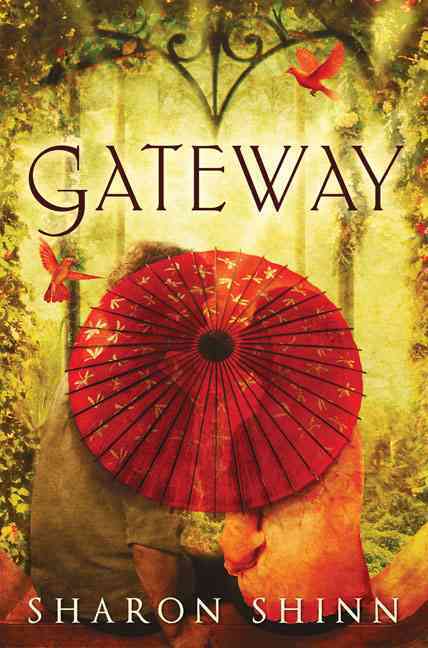
ECB: You’ve created a host of rich fantasy worlds, from the Biblical-inspired setting of the Samaria novels, to the fascinating segregated metropolis in Heart of Gold


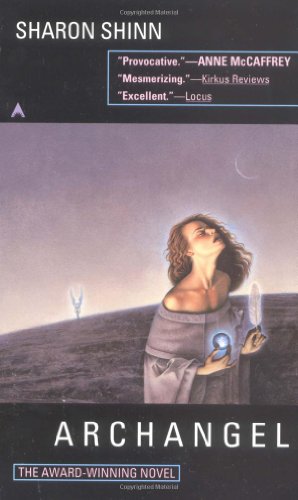
SS: I think it’s a lot harder to write in the real world. There are so many more places to go wrong! One throwaway line can wholly trip you up. Maybe a character says, “Oh, I used to go to that park when I was a little girl,” but it turns out the park wasn’t built until five years after the story is set. And some reader is going to know that. One good thing about writing in the real world is that my language choices become so much broader. I set a lot of books in semi-medieval and low-tech worlds, so there are hundreds of words that I don’t want to use because they sound too modern or technological. I also try to avoid words that seem too foreign (even though, of course, English is cobbled together from many languages!) But in a present-day real-world setting, nothing is off limits. In the book that comes out this fall, the main character talks about feeling “the oppressive G-force of disappointment.” Never could have used that phrase in Archangel


ECB: You’re very active in the fantasy community, making several convention appearances every year. Can you tell us why maintaining connections with fans and other writers is so important to you? And where might fans catch up with you next on the con scene?
SS: Science fiction writers belong to such an odd little subset of the human race that it can be a pretty lonely to be one. I didn’t discover the con scene until after my first book came out, and I had written quite a few manuscripts before then. All my friends and family members were very supportive, and they dutifully read my stories and told me they liked them, but they couldn’t help me get better. They didn’t understand when I’d borrowed an existing trope (they thought I invented shape-shifters!!!) And they didn’t entirely understand why I would WANT to spend my time hunched over a typewriter or a keyboard, trying to transfer these weird ideas from my brain to the page.
I love talking to other published authors because they understand the joys and frustrations of the writing life. They know what I mean when I say I hate my current book (though I loved it when I first started writing it and I eventually hope to fall in love with it again). They know why I dread reading copyedits. They nod in agreement when I say some friend wants me to go to a movie but I’d rather stay home and write because the characters are screaming in my head. And science fiction/fantasy writers have a whole different level of understanding! Conventions are where this scattered tribe comes together, so that’s one reason I like conventions.

I also love a chance to meet fans. Writing is a pretty solitary life, and living inside the pages of a book while you’re writing it is like being exiled to another country. When I meet people who’ve read and enjoyed one of my books, it’s like meeting other expatriates. And it makes me think that maybe, just maybe, all those hours sitting alone at the desk actually resulted in something worthwhile after all.
This year I’m planning to be at Chicon in August. Not sure if I have any other convention appearances planned. Hoping to go to Brighton for World Fantasy Convention in 2013… but that’s a long way off…
Sharon, thanks for talking with us today!
