


Review by C.J. Bunce
Re-released in book stores last month was Kim Newman’s alternate history/fantasy/steampunk-esque novel Dracula Cha Cha Cha


Unlike the many trite vampire-related offerings in the marketplace, Dracula Cha Cha Cha

Journalist and vampire Kate Reed has arrived in the city and takes up with a some notable vampires who end up dead, with Kate as a witness. Originally arriving to visit her sick ex-husband Charles Beauregard, ex-British non-vampire spy, she gets blamed for more than one murder, which mysteriously occur at the hands of a masked villain called the Crimson Executioner. The plot focuses on the relationship between three lovers/ex-lovers of Beauregard–Kate, as well as Geneviève Dieudonné–a 400 year old vampire who has the look of a 16-year-old and is caring for Charles at his death, and Penelope Churchward, also a vampire and longtime friend to Kate who wants to prevent the aging Charles from dying by finally “turning” him. As we follow Kate’s story she slides further and further into the underbelly of Rome and its vampire world, far more en vogue and seductive than the vampire world of Britain. Ultimately she is found drenched in blood at the site of the death of the famous Count with no memory of recent events. The Count himself only makes a brief appearance in the novel, at the first meeting with his wife-to-be, at his grand wedding.
Hot on the trail of a Russian spy with teeth like Jaws, a sharp-brimmed hat like Oddjob, and a white cat-like Blofeld from the movie You Only Live Twice, our spy Bond becomes intertwined in the two murder plots as he pays a visit to Beauregard, the elder and notable former spymaster from the Diogenes Club, the organization keeping an eye on Count Dracula’s actions. Bond still drives an Aston Martin, and drinks a “shaken, not stirred” blood martini. His lines are straight from the real-world Bond novels and even chapter headings are novel titles or plays on titles, such as From Moldavia with Love and Live and Let Die. Like an Ian Fleming novel, we get Bond engaged with a double-crossing Bond girl, some hand to hand fight scenes, including one where Geneviève must rescue Bond, and a great life and death car chase. Just as the new movie poster book cover evokes, Dracula Cha Cha Cha
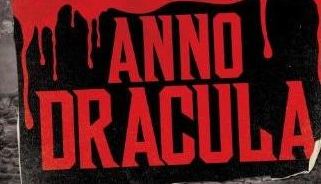
What really makes the world of 1959 stand out are the vivid descriptions of places, clothes, trends, and people. Newman pulls in anyone and everyone from fiction’s past–vampires live forever so he could select from 1888 to 1959 to populate his world–as well as tying in real-world characters, famous and infamous. This means Sherlock Holmes and Jack the Ripper co-existed, Orson Welles is a magician who gets interviewed as a witness to Dracula’s death, vampire Edgar Allan Poe is active in Italian culture in the 1950s, and Churchill, Dali and Errol Flynn co-occupy the world of Dr. No, Clark Kent, Fu Manchu, Michael Corleone and TV’s Addams family. Newman’s choices tend to have some tie to the world of Dracula–including real-life people who may have been in Dracula movies of the past, or fictional characters featured in Bram Stoker’s work or later adaptations and spin-off works. The societal strata resulting from a world where Dracula and vampires thrived and become the masters of haute culture, fashion, wealth and elite status is clever and engaging, even for readers who aren’t fans of the vampire genre.
Newman’s Italy will be familiar to fans of Michael Dibdin’s Aurelio Zen novels. Only here instead of cappuccino everyone goes to bars and coffee shops for their various blood drinks. Dracula Cha Cha Cha
A frothy and rich read, Dracula Cha Cha Cha


