


Danger, Will Robinson, Danger!
If those words mean nothing to you, it’s about time to get caught up on the classic sci-fi series Lost in Space, a series that, in its own way, rivals the original Star Trek and the Twilight Zone and even today surpasses in storytelling a lot of 21st century sci-fi series.
Although it still is not available via Netflix on streaming video, the 1960s sci-fi series Lost in Space is available in DVD season and boxed sets


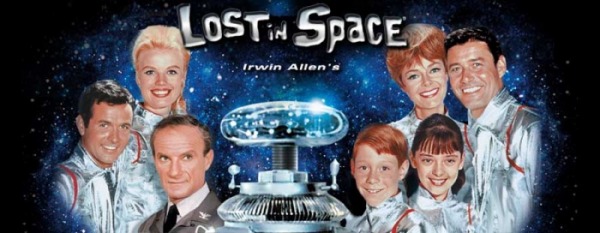
Making its debut in the 1960s only a few years before the moonshot, this sci-fi classic showcases the adventures of the Robinson family, who find themselves adrift in outer space when their mission to colonize the last frontier is sabotaged. It’s good in part because it is an adaptation of The Swiss Family Robinson


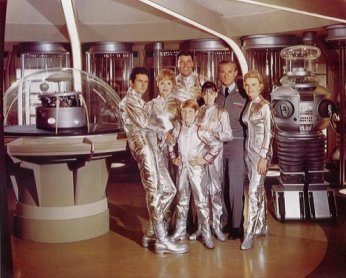
The third season episode “Condemned of Space” aired today. It was one of two episodes that featured Robby the Robot, one of the most famous sci-fi robots ever, who originally was featured in the classic sci-fi film Forbidden Planet.

Why is Lost in Space different from other sci-fi series?
It’s got a great theme song by none other than the great soundtrack composer and Boston Pops conductor John Williams (Star Wars, Raiders of the Lost Ark, E.T., The Extra-Terrestrial, Jurassic Park).
The opening credits alone were ahead of their time, whether you’re viewing the original black and white or the revised color introductions in later seasons. In season three look for a round forming symbol later used (intentionally or not) for the Imperials in the Star Wars trilogy.
The ship, the Jupiter 2, featured a crew before its time, half men and half women. Although there are several gender role issues you might frown a bit at today, like the fact that the youngest daughter Penny isn’t the whiz kid, and instead her little brother Will, the genius kid scientist, seems to talk down to her all the time, and both girls tend to be featured in emotional themed episodes. But sometimes even Penny gets to be the voice of reason and save the day. Again, ahead of its time.
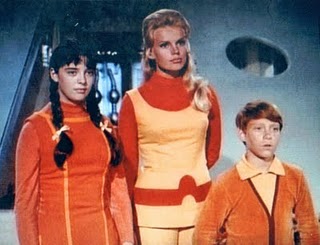
The cast didn’t phone in their performances, especially the evil Doctor Smith, who when he wasn’t evil he served a comic relief, allowing the kids to teach an adult lessons in kindness, ethics, and morality in several episodes. Jonathan Harris’s performances as Smith were so passionate and over the top that he often stole the show. He’s a little Mad Murdock from A-Team, a little Gaius Baltar from Battlestar Galactica. The rest of the cast included Guy Williams (Zorro, Bonanza) as Dr. John Robinson, June Lockhart as Dr. Maureen Robinson (Sergeant York, Lassie, The Drew Carey Show)–yes, a woman as a doctor on TV in the 1960s!–Mark Goddard as Major Don West (The Detectives, Johnny Ringo), Marta Kristen (My Three Sons) as Judy Robinson, Billy Mumy (Twilight Zone, Babylon 5), and Angela Cartwright (The Sound of Music, Logan’s Run) as Penny Robinson. And don’t forget the great B9 cybernetic character “The Robot” with flailing arms and blinking lights.
Monkeys in space! Penny had a companion chimp named Debbie.
Star Trek made use of red, yellow-green, and blue as the main Starfleet shirts, but Lost in Space stretched the bounds of TV sets’ color dials (remember those?) with its secondary colors and showed a vision of the future (ahem, the lift-off occurs in the future year 1997) with corduroys and velours.
Kids got to be smart and not the ones making mistakes–Will Robinson was the obvious idea behind Will Crusher on Star Trek: The Next Generation.
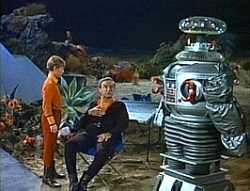
Adventure and fantasy in space–long before Star Wars was the greatest space fantasy of all time, Irwin Allen made Lost in Space bridge a look at our future with action and adventure stories. it’s hard not to compare the Salt Vampire and Gorn of Star Trek with every creepy creature the Robinson’s met stranded on various planets.
The only drawback for some viewers may be the dated clothes, the gender roles, and some melodrama, especially from Doctor Smith. But if you can put that aside Lost in Space is a fun series that is still watchable more than 40 years later.
C.J. Bunce
Editor
borg.com
