


By C.J. Bunce and Jason McClain
As we discussed yesterday, DC Comics has announced a new limited series to be released this year, Before Watchmen, focusing on the backstory, prequels, of each of the main characters of Alan Moore and Dave Gibbons’ classic comic book series, Watchmen


This week he was quoted in the New York Times as saying of Before Watchmen, “I don’t want money. What I want is for this not to happen” calling the effort “completely shameless” and adding “I tend to take this latest development as a kind of eager confirmation that they are still apparently dependent on ideas that I had 25 years ago.”
borg.com Hollywood writer Jason McClain and I have a lot in common, and a number of books and movies where we find ourselves on the opposite sides when it comes to analyzing works, especially ones receiving abundant critical acclaim. Jason introduced me to the graphic novel Watchmen several years ago. I read it and was not blown away by it. I didn’t care about the characters, in part knowing the cast was all based on Charlton Comics characters that DC Comics decided in the end they did not want updated by Moore in his series. In particular I didn’t care for either Dr. Manhattan, Moore’s take on Captain Atom, or Adrian Veidt, Moore’s take on Peter Cannon, Thunderbolt. That said, I liked Rorschach–he was Moore’s take on the Question, a character I’ve always been a fan of. I also liked Nite Owl, who although based on Blue Beetle seemed to me like a Batman knockoff–a good thing as some of my favorite characters fall in this category. And I liked Silk Spectre, who was based on Nightshade but heavily influenced by Black Canary. I liked these characters enough that I revisited the novel in advance of the movie premiering in March 2009 after Jason and I gazed at the cool Nite Owl ship at Comic-Con in 2008. I really liked Watchmen, the movie. Jason didn’t.
So we decided to investigate each other’s views further.
CB: Jason, why do you, and countless others, think Watchmen
JM: I read your email during a basketball game at a sports bar. It got me thinking so much that I realized I wasn’t watching the game anymore but thinking of a response. Two things come to my mind. The first is the design. My friend Kevin Eib pointed out to me that the layout of the appropriately named chapter five, “Fearful Symmetry” as Rorschach investigates the death of The Comedian before he gets captured, has symmetry in the colors and the panel sizes. If you start at the middle as Ozymandias hits his attempted assassin with a stanchion, you see the parallel in that panel, Ozymandias filling the left side and upright and in the right side, the villain, blood flowing out of his face as he falls to the floor head first and the “V” of “Veidt” centered in the background. You saw a reason for the art and the design besides a “bam” and “pow” delivery system.

Second are the characters. Before I read this, comics were pretty much the same, villain appears, hero stops him and everything is black and white. This was different. Were Rorschach and The Comedian heroes? They certainly didn’t behave that way and they knew it too. The Comedian got the joke. He just defended the people with money. That kind of grey reminds me of the Hard-Traveling Heroes

CB: I do like your Green Arrow analogy. In the comic book version of Watchmen, I just didn’t see the passion that the actors in the movie were able to bring to the characters. I found the artwork bland in the comic book and it didn’t engage me. I did recognize how either Moore or Gibbons liked the use of parallel panels, and I’ve seen that in other Moore works, but that seemed more like a visual gimmick to me. In the movie, even what I considered the best part of the comic book, Rorschach, seemed to be a lot more than the character in the comic. I guess I needed to see that facial special effect actually work. His life is a disaster and you really feel for this guy. And his relationship and past with Nite Owl was great. Even Dr. Manhattan, who I didn’t care for in the comic, made me at least understand where he was coming from in the movie, and the struggle to have meaningful relationships with Nite Owl and Silk Spectre made me care far more about these characters than in the book.

In the movie, The Comedian was vile. I didn’t have that reaction so much from the book. My wife and I were discussing the movie for weeks afterward. Don’t get me wrong, I am not saying that I prefer movies over comic books. Definitely not the case. I have read other comics over the years that dazzled me. As much as I don’t care for most of what Frank Miller has created, Batman: The Dark Knight Returns

JM: No, my own little joke at the expense of the other Moore movie adaptations.
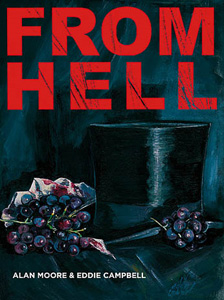
CB: Nice. As for From Hell… I am not a “big” fan of either the book or movie, although the movie is better in my mind because the mood is well done and Johnny Depp performed well in this period piece. Frankly I am tired of Jack the Ripper stories and think it is the most over-done subject choice for retelling in any medium. I think the best achievement in Jack the Ripper story is Malcolm MacDowell’s Time After Time


JM: I’m beginning to think it is a case of our feelings for the source material. I really like Alan Moore’s writings and therefore don’t care much for the adaptations. You’re probably not completely opposite, but because your feelings aren’t as strong for his written word, liking the movies become easier. (Though I have to admit that I didn’t read From Hell

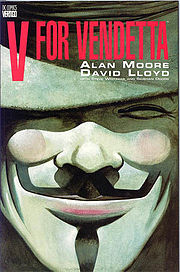
CB: I love that you used the phrase “his written word” to describe his work (he really has that “comic book god” mystique, doesn’t he?). But Moore seemed hypocritical to me in his comments in the New York Times last week. In V for Vendetta, he re-worked England’s Guy Fawkes story. In The League of Extraordinary Gentlemen


JM: I think you make a valid point. I hadn’t thought of it like that until you mentioned it. At the same time though, Alan Moore definitely made quite a few of these characters better after he played with them. He created new worlds, new stories and fresh dialogue. (I try to go back to read some of the dialogue of the comics of my youth and can barely get through a few pages before I wonder what I was thinking.) Anyone who creates something feels a sense of ownership. It’s like Krusty the Clown says in “Krusty Gets Kancelled”, “If this is anyone but Steve Allen, you’re stealing my bit.” How many retellings of Hamlet, Romeo and Juliet, MacBeth or Othello have there been over the ages? Or for more recent public domain works, A Christmas Carol or Emma?
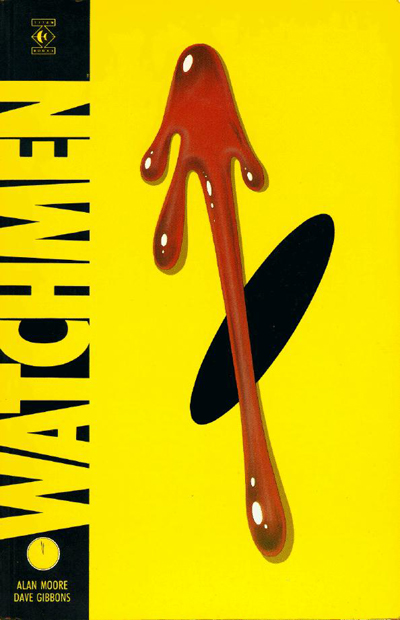
I think Moore comes across as a crotchety old man who tells the kids to get off his lawn, but I think we all do that. If I may extend the lawn analogy, what makes these characters popular is what he did to them, kind of like the weeding, fertilizing, watering and care that go into an old man’s fine lawn. Before he took in the characters, they were mostly unrecognizable under the slew of ever-increasing publishing weeds overshadowing them. (I may be overstating the lack of popularity of some these characters.) If they were still in their old forms, they’d have less of a market and right now he’s probably fighting an uphill battle to get more money (or control if you want to call it by its more genteel name) for his contributions though he didn’t create the grass. As I wrote this, I found myself thinking of Jerry Siegel and Joe Shuster. They created Superman, but because they did it under contract for the longest time they and their estates didn’t get any of the royalties associated with it. I’m sure Moore’s doing fine in comparison, but you still have to fight for what’s yours, even if you sound like Scrooge.
CB: Thanks, Jason. Next time maybe we’ll have to chat about Shawshank Redemption and The Green Mile.
