


Review by C.J. Bunce
Martin Caidin’s Cyborg


First, it is a medical thriller more than a dramatic work of science fiction. Cyborg
Caidin’s description of the crash was as an eye-witness of sorts, and the first three chapters read like nonfiction. Written before the space shuttle program, this type of mission reflected real missions of the time between the days of Apollo and the shuttle program, honing the technology leading to the first real mission with Space Shuttle Columbia. Shockingly, the crash scene is like a foreseen account of the actual real-life disaster of the Columbia space shuttle. The gritty realism of the first three chapters sets up the reader for a believable entry into the un-real that follows.
Colonel Steve Austin is a pilot who had already served as astronaut on the last moon mission, the last man to walk the surface of the moon. Waiting to go off as an astronaut on some Skylab mission he is now at a Mojave Desert test launch, which is vividly described. Jan Richards is his girlfriend, all too familiar with being the spouse of an astronaut and the circumstances that come about on launch days, and although she has been there before, she is still nervous. We learn quickly that Colonel Austin is a stunt pilot every bit like the Chuck Yeager as detailed in Tom Wolfe’s The Right Stuff. He is confident if not cocky. Like Han Solo, in response to his girlfriend’s “I love you, Steve Austin,” he responds, “Same here.”
The fact that author Martin Caidin actually participated in the real-life NASA counterpart to the program in which Austin crashes adds a heightened realism to the novel. Caidin was on site when a pilot suffered a similar terrible accident–the same type of disaster that aired at the beginning of each Six Million Dollar Man episode and makes up the first part of the novel.
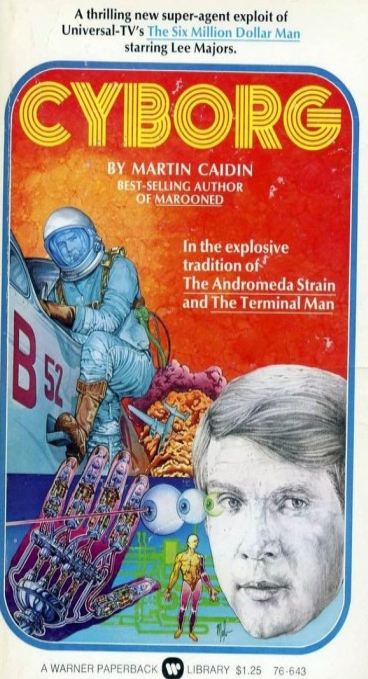
Steve Austin, seriously injured as a triple amputee, gets not prosthetics, but improved-upon artificial limbs and an artificial eye. But first we get accounts of medical triage, a play-by-play account of the cutting off of Austin’s blood loss, the overall success of protecting the body from burns because of the NASA flight suit, loss of both his legs and left arm, loss of eye through metal debris in the cockpit, skull damage, jaw damage, skin damage, assessment of respiratory damage, standard procedures from placing the intubation tube to removing the space suit from what remains of his body.
Doctor Milton Ashburn, head of emergency response, after hours go by, finally utters the words “He’ll live.” But then all the conflict and story begins, starting from the lowest of places: “If you love that man like I do… then pray that he dies.”
If you’ve seen people recovering from surgeries, it is all about pain and lots of recuperation time. It’s what I thought was missing for the first third of the book, then Caidin goes into detail about nerve endings and compensation for missing limbs. To the layman even in 2012 it all seems to make sense. Instead of brushing over the details of creating a cybernetic organism–a cyborg–he details all the processes and only in the last 20 percent of the novel do we get to the reason the government is willing to pay $6 million to keep this one man alive, and more than that, make him superhuman. It is of course to make him a super soldier.
As storytelling is concerned, Cyborg is part Wolfe’s The Right Stuff


The second third of the novel brings the realization that this in a real and thoughtful sense is a modern retelling of Mary Shelley’s Frankenstein

Once we get past months of recovery, recuperation, and therapy, and Austin getting to know his new body and abilities, the last third of the novel is a cross between Tom Clancy’s The Hunt for Red October


Great survival references are included in the final chapters including a bit about the real-life B-24 bomber downed decades ago in the desert called the Lady Be Good (documented in an episode of the History Channel’s History’s Mysteries in the 1990s).
Cyborg
I’ve had the fortune of meeting and talking to three of the 12 surviving United States Apollo program astronauts who flew to the moon, and their confidence and character were well mimicked by Caidin’s account of the fictional Colonel Austin. Clearly Caidin spent time with these guys in real life, and it is reflected in his book.
Cyborg
